

Payment modules for vending machines
Nowadays, vending machines can be equipped with a wide variety of payment systems. From contactless payment via smartphone to traditional payment with cash.


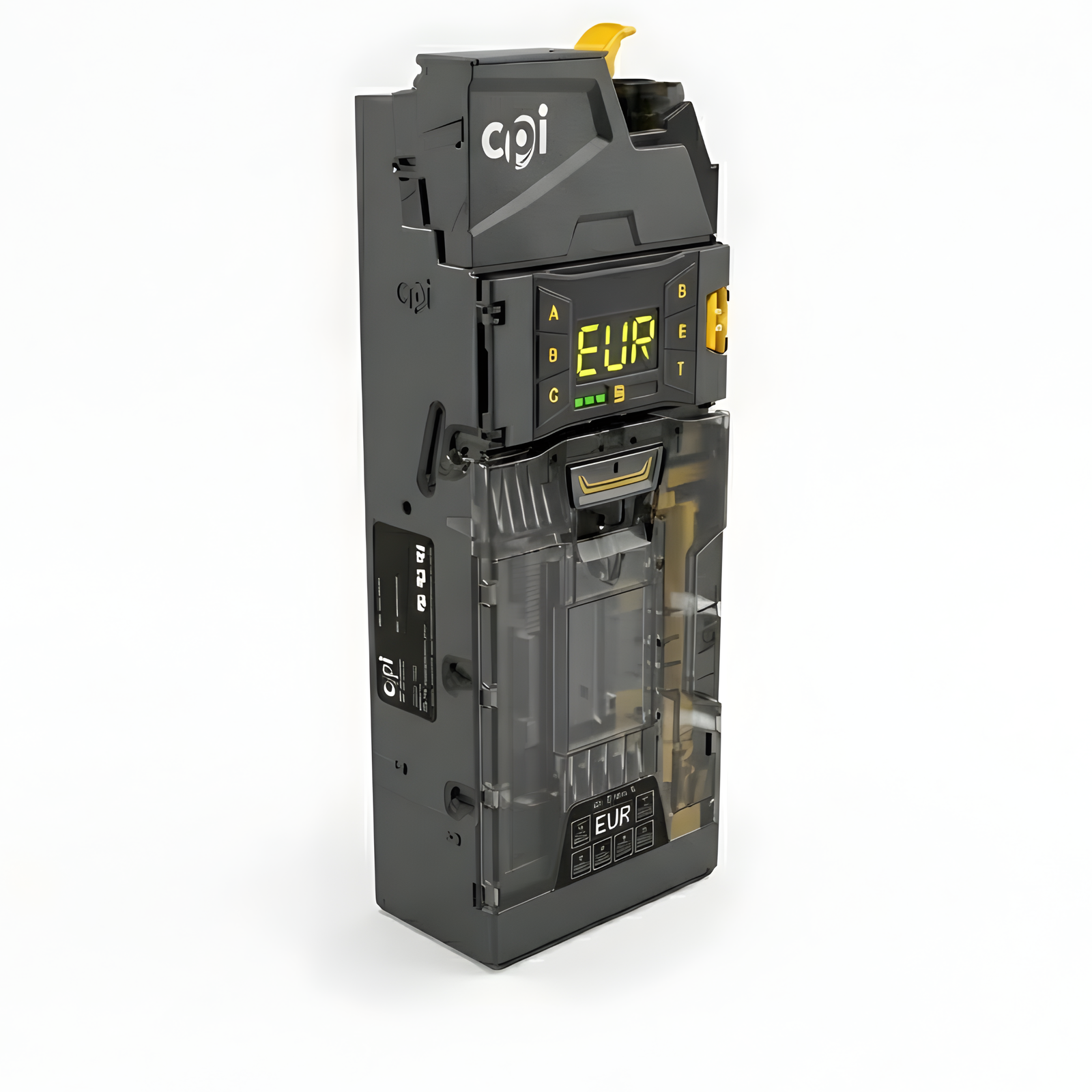


How does a bill acceptor work?
A bill acceptor, also known as a banknote acceptor, is a device in vending machines that accepts, checks and processes banknotes. Here is a step-by-step explanation of how such a bill acceptor works:
1. inserting the banknote
- The user inserts the banknote into the slot provided in the machine. The acceptor automatically draws in the bill.
2. checking the banknote
- Mechanical check: The banknote is transported through a series of rollers and sensors. These first check whether the bill has the correct dimensions (length, width, thickness). This helps to rule out folded or damaged bills.
- Optical check: Cameras and sensors scan the surface of the bill to recognize the patterns, serial numbers and other specific features used to distinguish genuine from counterfeit bills.
- Magnetic check: The acceptor checks whether the correct metallic security threads and inks are contained in the bill, which are used on genuine banknotes.
- Infrared and UV light inspection: The bill is analyzed under infrared and UV light to check special features such as watermarks, holograms and other security features.
3. identification of the value
- As soon as the bill is recognized as genuine, the acceptor identifies the value of the bill. This is done by comparing the recognized features with the data stored in the device.
4. acceptance or return
- Acceptance: If the bill is recognized as genuine and valid, it is transported to the collection box inside the machine. The corresponding amount is then credited to the user's balance on the vending machine.
- Return: If the ticket is recognized as invalid, damaged or counterfeit, it is rejected and returned to the user.
5. credit display
- The display of the vending machine now shows the loaded credit that the user can use to purchase products in the vending machine.
6. processing and billing
- At the end of a cycle, when the vending machine is emptied, the collected banknotes can be removed from the collection container and counted. The machine usually logs the amounts deposited and can make this data available for billing and accounting purposes.
Maintenance and calibration
- Bill acceptors require regular maintenance to ensure that they function correctly. This includes cleaning the sensors and rollers as well as occasional calibrations to ensure that the acceptor continues to recognize and process all bills correctly.
How does a coin changer work?
A coin changer in a vending machine is a complex system that recognizes, counts and sorts coins and dispenses change as required. Here is a detailed explanation of how such a coin changer works:
1. inserting the coins
- The user inserts one or more coins into the coin slot of the machine. The coins fall into the coin changer, which picks up the coins and passes them through a checking and sorting process.
2. detection and validation
- Mechanical inspection: The coins pass through various mechanical sensors that measure their size (diameter and thickness) as well as their weight. This helps to sort out counterfeit or damaged coins.
- Magnetic and electrical properties: Some coin changers use magnetic fields to check the magnetic properties of the coins. In addition, electrical sensors can measure the conductivity of the coins to identify the material of the coins.
- Optical verification: Some systems use optical sensors or cameras to check the color and appearance of the coins to ensure that they correspond to the accepted currencies.
3. identification of the value
- Once the coin has been recognized as valid, the coin changer identifies its value. The coin's data (size, weight, material) is compared with the information stored in the system to determine the coin's face value.
4. sorting
- After the value has been determined, the coins are sorted. The coin changer feeds the coins through an internal channel system that separates them by value. Each type of coin is fed into a specific coin hopper or tubes where it is stored until it is either dispensed as change or collected.
5. change mechanism
- If a user inserts more money than is required for the purchase, the coin changer automatically calculates the change to be dispensed.
- Dispensing the coins: The coin changer removes the appropriate coins from the tubes and returns them to the user through the coin dispensing chute.
- Optimization: Some coin changers are programmed to dispense change as efficiently as possible by using the largest coins available to minimize the number of coins dispensed.
6. monitoring and management
- The coin changer continuously monitors the amount of coins in the various tubes. If a tube is almost empty, the machine can indicate that no more coins of that type will be accepted, or automatic refills can occur if the machine is regularly serviced.
- In addition, all transactions are recorded so that the operator has an overview of the revenue and the stock of coins at all times.
7. maintenance and fault management
- Coin changers require regular maintenance to ensure that they function properly. This includes cleaning the sensors, removing blocked coins and refilling the coin tubes.
- In the event of errors or malfunctions, the machine can inform the user that the coin changer is currently not working and offer a cashless payment as an alternative.
Payment modules Nayax VPOS Touch and Nayax Onyx: The payment systems for cashless payments
The Nayax VPOS Touch and Nayax Onyx are more than just a card reader - it's an all-in-one platform that offers your customers a seamless and secure payment experience and gives you as an operator complete control over your payment processes.
Innovative design and ease of use
The Nayax VPOS Touch and Nayax Onyx have a sleek and modern design that integrates perfectly into any retail environment. The intuitive touchscreen display enables quick and easy operation for both your customers and your staff. The user-friendly interface allows payments to be processed efficiently, resulting in improved customer satisfaction.
Comprehensive payment acceptance
With the Nayax VPOS Touch and Nayax Onyx, you are well equipped for the future of payment processing. The devices accept a variety of payment methods, including credit and debit cards, mobile payments such as Apple Pay and Google Wallet, as well as contactless payments (NFC). This versatility ensures that you won't lose any potential customers, regardless of which payment method they prefer.
Security at the highest level
At a time when data security is of paramount importance, the Nayax VPOS Touch and Nayax Onyx offer state-of-the-art security features that meet the highest industry standards. The integrated encryption technology ensures that all transactions are safe and secure. The devices are also EMV and PCI DSS certified, giving you and your customers additional protection and confidence.
Real-time monitoring and analysis of payments
The Nayax VPOS Touch and Nayax Onyx not only offer you a reliable payment system, but also powerful analysis and reporting tools. Thanks to real-time monitoring, you always have access to detailed reports on your sales figures, transactions and much more. This information helps you to make informed business decisions and increase your operational efficiency.
Easy integration of payment modules
The Nayax VPOS Touch and Nayax Onyx can be easily integrated into existing systems and are compatible with a wide range of vending machines, kiosk systems and point-of-sale devices.